
Ever sat at a blackjack table and wondered if that elusive joker card could pop up in the deck? Or maybe you’ve heard about special game variations that change the rules you know so well.
Whether you’re new to blackjack or you can spot every card in the pack at a glance, knowing whether jokers belong in the deck helps you understand which games follow the familiar rules and which ones play differently.
There are plenty of myths and house rules around jokers. This guide explains where the joker belongs, how it can alter play when it does appear, and the kinds of variants you might see in informal settings.
What Is the Joker Card?
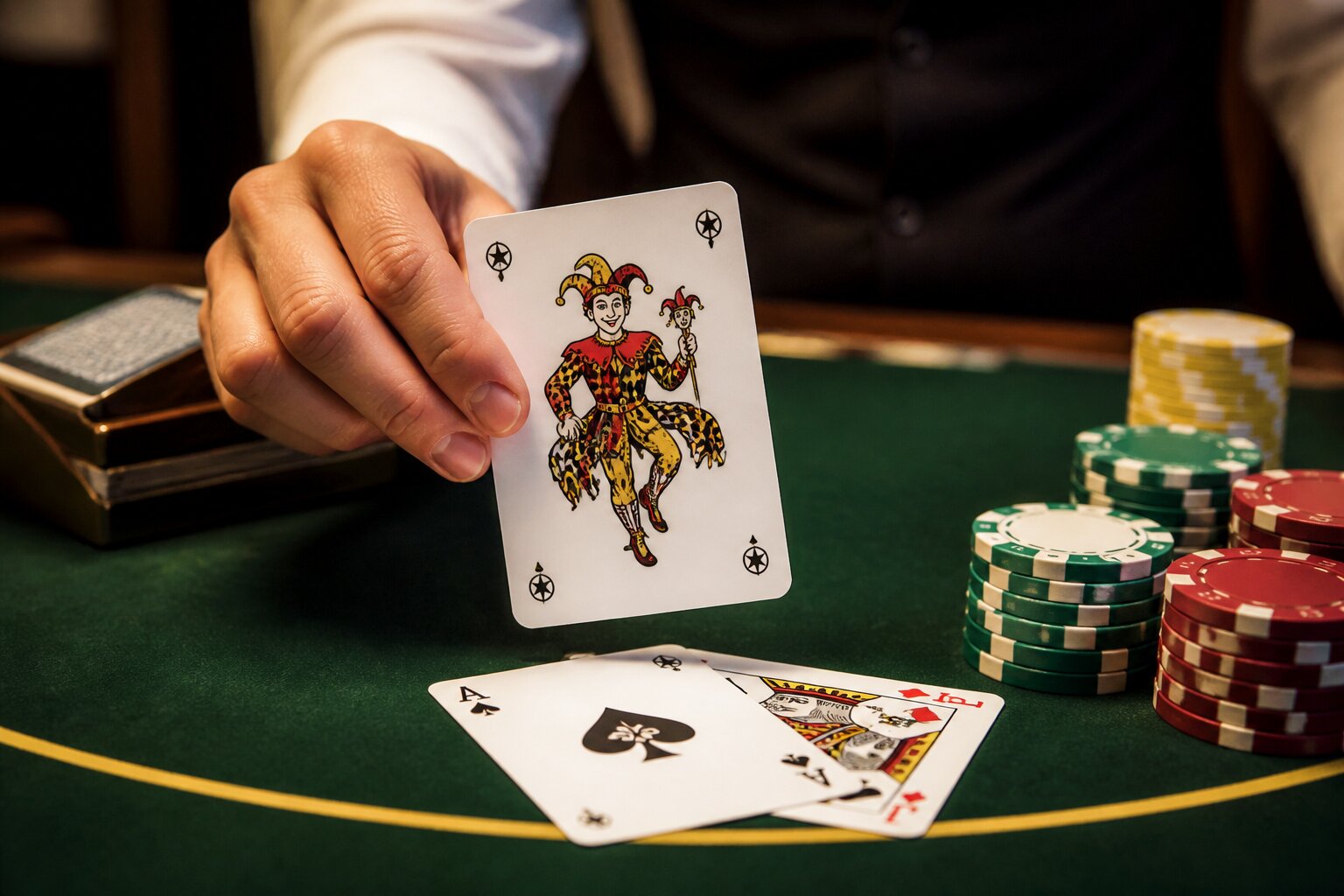
The joker is an extra card found in most modern packs, separate from the four suits: hearts, diamonds, clubs and spades. Decks commonly include two jokers, and their artwork tends to be distinct from the numbered and face cards.
In several card games the joker acts as a wild card, substituting for other cards to complete combinations or break ties. Rules vary widely from game to game: sometimes a joker has a defined value, sometimes it can become whatever the player needs.
Although jokers turn up in family and club games such as Rummy and Canasta, they are not a universal component. Their presence and function depend entirely on the rules chosen for that particular game.
For casino-style play, the joker is generally an optional, non-standard element reserved for novelty or home variants rather than regulated table games.
Does Blackjack Use Joker Cards?
Standard blackjack uses only the 52 cards in each suit: ace through king. Jokers are not part of traditional blackjack play, so you will not see them in the usual casino or online versions.
If a joker appears during a regulated or professionally run game, it is normally a mistake and will be removed by staff. In casual or private games, however, house rules might permit jokers for a change of pace.
Knowing this difference helps you set expectations: when you sit down at a recognised table, the game follows the familiar 52-card format; when you join a social game, ask about any special rules first.
Why Are Jokers Rarely Included in Blackjack?
Blackjack is built around a fixed system of card values and standardised hand calculations. Introducing jokers would disrupt that balance because they act as flexible, non-standard cards rather than fixed-value components. Their presence would change how hands are valued and how basic strategy is derived, making many long-established decisions less reliable.
Keeping to the 52-card structure preserves the mathematical framework behind decisions such as:
- hitting,
- standing,
- splitting,
- doubling down.
It also maintains consistency across tables and platforms, so players can apply the same strategies and understand the odds of common situations. That consistency supports fair play, predictable house edge calculations and easier comparison of rules between venues.
For operators and organisers, excluding jokers simplifies rules and reduces disputes. Adding jokers would require bespoke rules that cover how the card behaves in different situations, how it interacts with existing rules and how payouts are handled, which increases complexity for both staff and players.
Including jokers would also affect operational matters such as:
- dealer training and procedure,
- shuffling and shoe composition,
- card counting and long-term odds.
Because of these practical and mathematical considerations, most casinos and game designers prefer to leave jokers out of blackjack to keep play straightforward, transparent and consistent.
How Does a Joker Change the Rules If Used?
When a joker is deliberately included, it usually becomes a wild card and alters hand construction. In practice this means a joker might be used to represent any card value needed to complete a hand or reach a target.
Different variants handle jokers in different ways. Some allow a joker only to complete a blackjack; others permit it to take any numerical value or trigger special payouts. Those adjustments shift strategy: decisions about whether to draw another card or stand can become more complex because the potential outcomes change.
Any game that uses jokers will need explicit rules about how the joker is assigned a value, whether it can be split, and how it affects dealer play and payouts. That clarity is essential to keep gameplay fair and to prevent confusion at the table.
Card Game Variations: When Is the Joker Allowed?
Jokers are most often found in private or informal versions of blackjack. Home games and social clubs sometimes add jokers to make a variant that feels different from the standard table game.
These versions are not the same as the standard casino game and should be treated as an alternative experience. If you’re invited to a variant, ask for the specific rules: how many jokers are used, what values they can take and whether they change the payout structure.
House rules can vary wildly. One group might allow a joker solely as a replacement to make 21, while another might attach bonus payouts to hands containing jokers. Understanding these differences helps you make informed choices about whether to join a particular game.
House Rules and Home Game Differences
At home, the presence and function of jokers depend entirely on the group’s agreement. Rules might specify when a joker can be used, whether it counts as an ace or a numerical card, and how it interacts with splits and doubles.
Because these changes are for entertainment rather than formal competition, the emphasis is on clarity and fairness among players. Being clear about the rules before play starts avoids misunderstandings and keeps the game enjoyable for everyone.
Common Myths About Jokers in Blackjack
A persistent myth claims jokers are a normal part of every blackjack deck. In reality, they are absent from standard play and only appear in variants where players have explicitly agreed to include them.
Another misconception is that jokers automatically improve one’s chances of a favourable outcome. While jokers can change the distribution of possible hands in a variant, their inclusion does not guarantee better results; it merely alters strategy and pay tables.
Some players think jokers trigger special rounds or payouts in regular casino blackjack. That is not the case in standard games. If a game does feature unusual cards or bonus conditions, those will be clearly stated in the rules before play begins.
If you are ever unsure, ask the host or check the game rules. Clear information prevents surprises and helps you decide whether a variant is right for you.
Should You Play Blackjack Variants With Jokers?
Choosing to play a joker variant comes down to whether you want a different experience and whether the rules are transparent. In regulated settings and most commercial venues the standard 52-card game prevails; variants with jokers belong to private and novelty play.
Consider how the joker changes decisions at the table and whether the payout structure is fair and understandable. If the rules are well defined and you enjoy a more unpredictable style of play, a joker variant can be an entertaining diversion. If you prefer consistency and well-established strategy, stick with the traditional format.
Consider the Rules and Fairness
Before playing any variant, ensure the group or operator provides clear rules on joker use, hand outcomes and payouts. This helps everyone make informed choices and keeps the game honest.
Playing within clear boundaries makes the experience better for all involved and removes ambiguity about what happens when a joker appears in a hand.
Responsible Gambling Is Key
Play within set financial limits and stop if the activity stops feeling enjoyable. If gambling causes concern, there are support services and tools available to help manage play.
Final thought: jokers have a role in some home and novelty blackjack games, but they are not part of the standard casino experience. Knowing that distinction lets you pick the version that suits you and play with confidence.
**The information provided in this blog is intended for educational purposes and should not be construed as betting advice or a guarantee of success. Always gamble responsibly.