
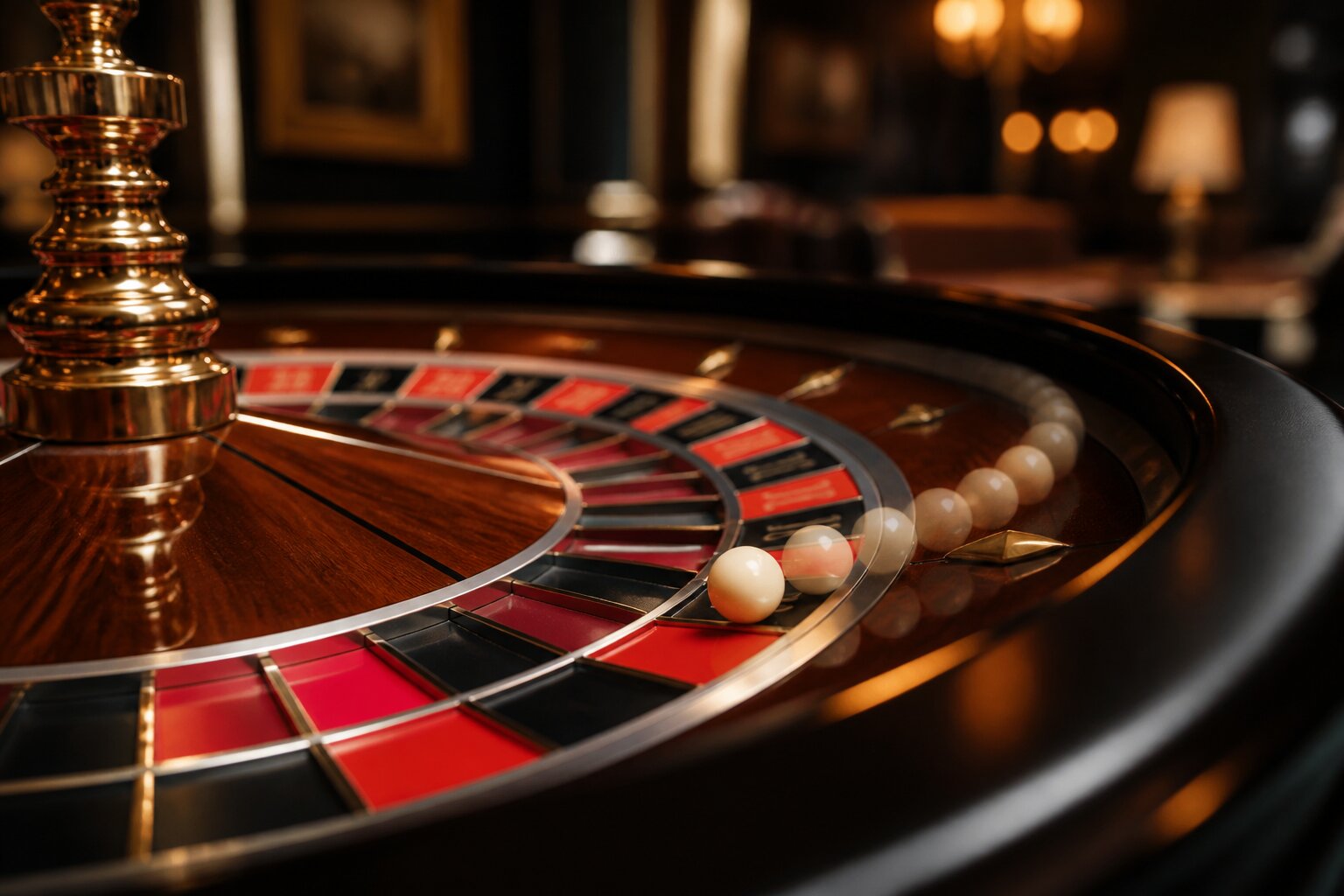
Ever watched the roulette wheel spin and wondered if the same number could come up twice? Seeing a repeat can feel surprising, but the reality rests on clear probabilities rather than intuition.
This article explains how repeats occur, what the maths says about consecutive appearances, and how the game's built-in advantage affects outcomes. Read on to get a straightforward picture of what repeated numbers really mean.
Understanding Roulette Number Repeats
A number repeat simply means a specific pocket appears more than once during a playing session. The clearest form is a consecutive repeat, where the same number lands on two or more spins in a row, for example 17 on successive spins. Other repeats happen with gaps in between: a number may show up, disappear for several spins, then reappear later in the session.
Distinguishing these types matters because they feel different to a player. A consecutive repeat grabs attention because it looks like a streak, while non-consecutive repeats are easier to overlook yet equally part of normal play. Both types arise from the same underlying randomness that governs each spin.
Now that the idea of repeats is clear, the next section looks at how often they actually happen in practice.
How Often Does the Same Number Come Up in Roulette?
Each spin of the wheel offers a fixed probability for any given number. On a European wheel with 37 pockets (0–36), a single number has a 1 in 37 chance on one spin. The chance of that same number appearing twice in a row multiplies those independent probabilities, giving 1 in 1,369 on a European wheel. On an American wheel with 38 pockets, the corresponding figures are 1 in 38 and 1 in 1,444 for a consecutive repeat.
In sessions of many spins, individual numbers will recur with some regularity. Over a long run, each number should appear approximately the same proportion of the time, but short sample sizes show natural fluctuations. It is common to see some numbers two or three times in 100 spins and others less often; occasional runs of repeats are part of those random fluctuations.
With those odds in mind, the following section examines the factors players often think influence repeats and why the maths remains the primary explanation.
Factors That Influence Repeated Numbers
Several elements shape how repeats are perceived, though they do not change the fundamental probabilities of each spin. Perception is influenced by psychology, by the environment around the game, and by simple statistics, but the maths that govern each spin remain constant.
Wheel Design & Game Type
The number of pockets sets the base probability. A European wheel has 37 pockets and an American wheel has 38, so the chance of any particular number appearing is slightly lower on the American wheel. That small numeric difference changes the precise odds, but it does not create any tendency for repeats to occur more often than pure chance dictates.
Beyond that numeric difference, factors such as wheel balance, maintenance and the specific mechanics used in some electronic or live games can affect long term fairness if they are faulty, but they do not make repeats more or less likely in any meaningful way when the equipment is functioning correctly. In properly regulated play the wheel design only defines the sample space, not a bias toward repetition.
Independent Spins & Probability
Every spin is independent. The outcome of one spin does not alter the chance on the next spin. This independence is a core property of random events in roulette and similar games, so the same calculations for consecutive repeats simply multiply the single-spin probabilities.
Mathematically, if a single number has a one in 37 chance on a European wheel, the probability of that number appearing twice in a row is one in 37 squared. That approach extends to any number of consecutive spins and is why sequences that look unusual are still fully consistent with independent random trials.
Common Player Misconceptions
Players sometimes think a number is “due” after an absence or that a recent appearance makes a repeat less likely. Those ideas come from cognitive biases rather than mathematics. Many people use pattern-seeking instincts to impose order on randomness, and that can lead to mistaken beliefs about how future spins will behave.
Patterns and streaks will emerge in random sequences, but they do not provide a reliable basis for predicting future spins. Understanding that randomness can produce runs and clusters helps explain why surprising sequences are not evidence of a change in the underlying chances.
Having considered these influences, it is worth looking specifically at how plausible back-to-back repeats are and what the numbers say about their rarity. The next section examines concrete probabilities and puts occasional streaks into proper statistical context.
Are Consecutive Roulette Numbers Possible?
Consecutive repeats are entirely possible because randomness does allow for short streaks, but they remain infrequent by the probabilities outlined earlier. On a European wheel, the two-spin combined probability for a specific number is 1 in 1,369; on an American wheel it is 1 in 1,444.
Real-world tables occasionally show consecutive hits, and stories of remarkable runs circulate among players. Those episodes are simply extreme values within the range of possible outcomes and do not indicate any change in how future spins will behave. Expecting such repeats regularly overstates how often they occur.
Next, consider how the game's payout structure interacts with these outcomes and why the casino retains an edge regardless of repeats.
House Edge & Repeated Spins
The house edge is the mathematical advantage built into roulette payouts. A straight-up bet pays 35 to 1, while the true odds on a European wheel are 36 to 1 against a win, which creates a 2.7% edge for the house; on an American wheel the edge is about 5.26% because of the extra pocket. This margin applies to every spin, including those that produce repeats.
Repeats do not change payout rules or the house edge. If a number appears twice in a row, the bet structure and expected returns remain unchanged; short-term results do not erode the mathematical advantage. Keeping this in mind helps frame bankroll choices and expectations during play.
Understanding the edge leads naturally to a closer look at whether it is possible to detect patterns that could defeat that advantage.
Can Patterns Really Be Detected in Roulette?
Humans are pattern-seeking by nature, so clusters of the same number or long runs of a colour will draw attention. However, neither clusters nor perceived trends provide a dependable method to predict future spins. Random number generation in digital games and strict standards for physical wheels are designed to preserve independence between spins.
The gambler’s fallacy—believing an outcome is more or less likely because of recent history—captures the central mistake when interpreting patterns. Observed streaks are simply part of random sequences. No amount of pattern-spotting alters the probabilities or the house edge, and strategies based on detecting repeats cannot change the long-term mathematical balance.
With the maths, the wheel design and the role of probability in mind, the final point to take away is straightforward: repeats are expected sometimes, rare consecutives will happen occasionally, and each spin remains an independent event governed by fixed odds.
Play Casino Games at Easy Slots
Ever thought about finding a new spot to unwind and experience some casino fun? We welcome you to our site, where you can enjoy a relaxed atmosphere at your own pace.
It’s easy to get going with us—just create your account, make a deposit, and you’re all set to play. We look forward to seeing you at Easy Slots!
**The information provided in this blog is intended for educational purposes and should not be construed as betting advice or a guarantee of success. Always gamble responsibly.