
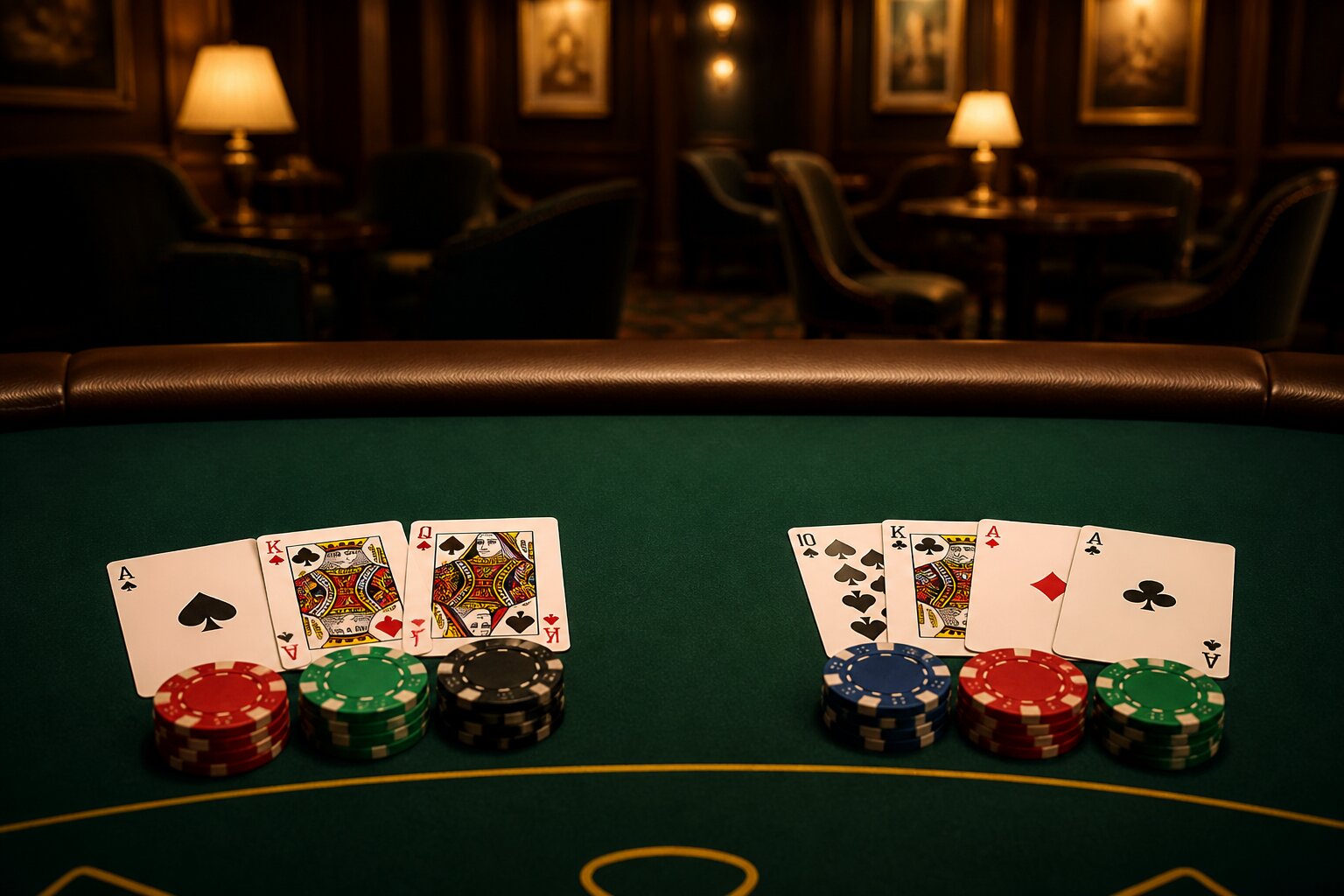
If you’ve ever sat at a casino table and wondered whether to play 3 Card Poker or stick with Blackjack, you’re in good company. Both games are popular for different reasons: one is fast and simple, the other offers room for decision-making and strategy.
This article compares the two across rules, odds, player experience and accessibility so you can choose the game that fits your style and bankroll.
Read on for a clear, balanced look at how they differ and what to expect at the table.
What Are the Key Differences Between 3 Card Poker and Blackjack?
Though both use standard playing cards, 3 Card Poker and Blackjack work very differently in structure and objectives. In 3 Card Poker you receive three cards and try to make the best poker hand to beat the dealer’s qualifying hand; play is head-to-dealer rather than player-against-player. Rounds are brisk because decisions are limited to folding or continuing.
Blackjack revolves around reaching a total as close to 21 as possible without exceeding it. Players start with two cards and can request additional cards or stand, and there are more decision points such as doubling down or splitting pairs. The dealer follows a fixed set of rules once player turns end, which makes Blackjack a more deliberative game.
These differences affect tempo, strategy and how much influence your decisions have on the outcome. If you prefer straightforward, repeatable rounds, 3 Card Poker fits. If you like choices that can influence your expected return, Blackjack offers that possibility.
How Do the Rules of Each Game Work?
3 Card Poker begins with an ante bet; you and the dealer each receive three cards. After seeing your hand you can fold, forfeiting the ante, or place a play bet to continue. The dealer’s hand must meet a minimum rank (commonly Queen-high or better) to qualify; payouts depend on how your hand compares and whether the dealer qualifies. Optional bonus bets pay out for specific high-ranking hands but generally carry a higher cost over time.
Blackjack starts with two cards to each player and the dealer, with one dealer card face down. Cards 2–10 are worth their face value, face cards count as 10 and Aces can count as 1 or 11. Players choose whether to take additional cards or stand, and may have options such as doubling or splitting depending on the house rules. After players finish, the dealer completes their hand according to fixed rules, and hands are compared to determine wins and losses.
Rule variations between venues can change the details — such as when the dealer hits on a soft 17 or the exact qualifying rank for 3 Card Poker — so it’s sensible to check the specific table rules before playing.
Which Game Offers Better Odds for Players?
Blackjack typically offers a lower house edge than 3 Card Poker when players use an appropriate strategy. In favourable Blackjack variants, the house edge can be around 0.5% with sound decision-making, though rule changes and player choices can increase that figure. This relatively low margin is why Blackjack is often described as one of the casino games where skillful play matters most.
3 Card Poker usually shows a higher house edge on the main game, commonly in the 3% region for typical paytables. Optional bonus bets in 3 Card Poker tend to have substantially higher house edges, so while they reward big hands, they cost more in the long run.
These percentages represent long-term averages; individual sessions can vary considerably. Use the odds as one factor among many — such as pace and enjoyment — when choosing a game.
Comparing the House Edge: 3 Card Poker vs Blackjack
The house edge expresses the casino’s expected profit from bets over time. In Blackjack, the edge depends on game rules and player choices; applying correct strategy narrows the edge, while deviations widen it. Variations like number of decks, dealer standing rules and surrender options all influence this figure.
For 3 Card Poker, the main ante/play structure generally yields a higher house edge than Blackjack. Paytables and the requirement for the dealer to qualify are the key influences. Side and bonus bets often inflate the house advantage further, despite their attractive payouts.
Understanding how specific table rules and bet types affect the house edge helps you make informed choices. If minimising the casino’s advantage matters to you, favour versions of Blackjack with player-friendly rules and avoid high-edge side bets.
Is 3 Card Poker or Blackjack More Beginner-Friendly?
Many newcomers find 3 Card Poker easier to pick up because each round requires only a single decision after the deal. That simplicity reduces cognitive load and lets players focus on enjoying the game rather than memorising moves.
Blackjack takes a bit longer to learn well because of the range of decisions available and how those choices alter expected returns. Players who invest a short amount of time in learning basic strategy often feel more in control and may improve their expected results, though nothing guarantees individual outcomes.
If you want a gentle introduction to casino table play, 3 Card Poker provides a quick route in. If you prefer a game where learning influences the odds, Blackjack rewards that effort.
Player Experience: Atmosphere and Social Elements
A 3 Card Poker table tends to feel light and sociable; because everyone plays the dealer rather than each other, conversation comes easily and the game’s quick rounds keep the energy moving. That can make it appealing for groups or newcomers who enjoy casual interaction.
Blackjack tables can be more focused, as players watch their totals and the dealer’s exposed card closely. Yet social moments arise, especially when players discuss strategy, celebrate strong hands or react to tight finishes. The game's mix of quiet concentration and convivial exchange suits players who like both strategy and company.
Whether you play in a bricks-and-mortar casino or at a live online table, both games offer a social component — choose the atmosphere that best matches how you like to spend time.
Are There Common Myths About 3 Card Poker and Blackjack?
There are several persistent misconceptions worth addressing. One myth is that memorising a fixed set of “secret” plays guarantees success; in truth, no approach can alter the statistical advantage the house holds. In Blackjack, learning basic strategy helps reduce the house edge, but it doesn’t eliminate it.
Another misconception is that other players can deliberately change your chances at the table. While player choices affect how a particular round unfolds, the dealing and outcomes follow established game mechanics rather than player intent. Similarly, claims that veterans can predict exact outcomes in 3 Card Poker overstate what experience can do; speed and pattern recognition aid decisions, but they do not determine results.
Clearing up these myths helps set realistic expectations and makes gameplay more enjoyable.
How to Choose the Right Game for You
Choosing between 3 Card Poker and Blackjack is mainly about what you want from the session. Consider whether you prefer shorter, less technical rounds or a game where decisions can alter expected returns. Think about your bankroll and the table minimums — smaller budgets often suit faster, simpler games because you can play more hands for the same outlay.
Also reflect on how involved you want to be. If you enjoy thinking through options and refining technique, Blackjack offers that engagement. If you prefer quick cycles and a lighter learning curve, 3 Card Poker will feel more comfortable.
Decide beforehand how much time and money you’re prepared to spend and pick the game that aligns with those limits. Keeping expectations realistic and setting personal boundaries helps make the experience sustainable and enjoyable.
Conclusion: Which Card Game Stands Out?
Both games have clear strengths. 3 Card Poker is user-friendly and brisk, ideal when you want uncomplicated rounds and social play. Blackjack gives more scope for strategic choices and can offer a lower house edge when you play with sound tactics and favourable rules.
The right pick depends on your priorities: simplicity and speed, or strategic engagement and potentially better long-term value. Choose the game that matches your style, check the specific table rules before you play, and keep within the limits you set for time and spending. That way you’ll get the most from whichever card game you decide to play.
**The information provided in this blog is intended for educational purposes and should not be construed as betting advice or a guarantee of success. Always gamble responsibly.