
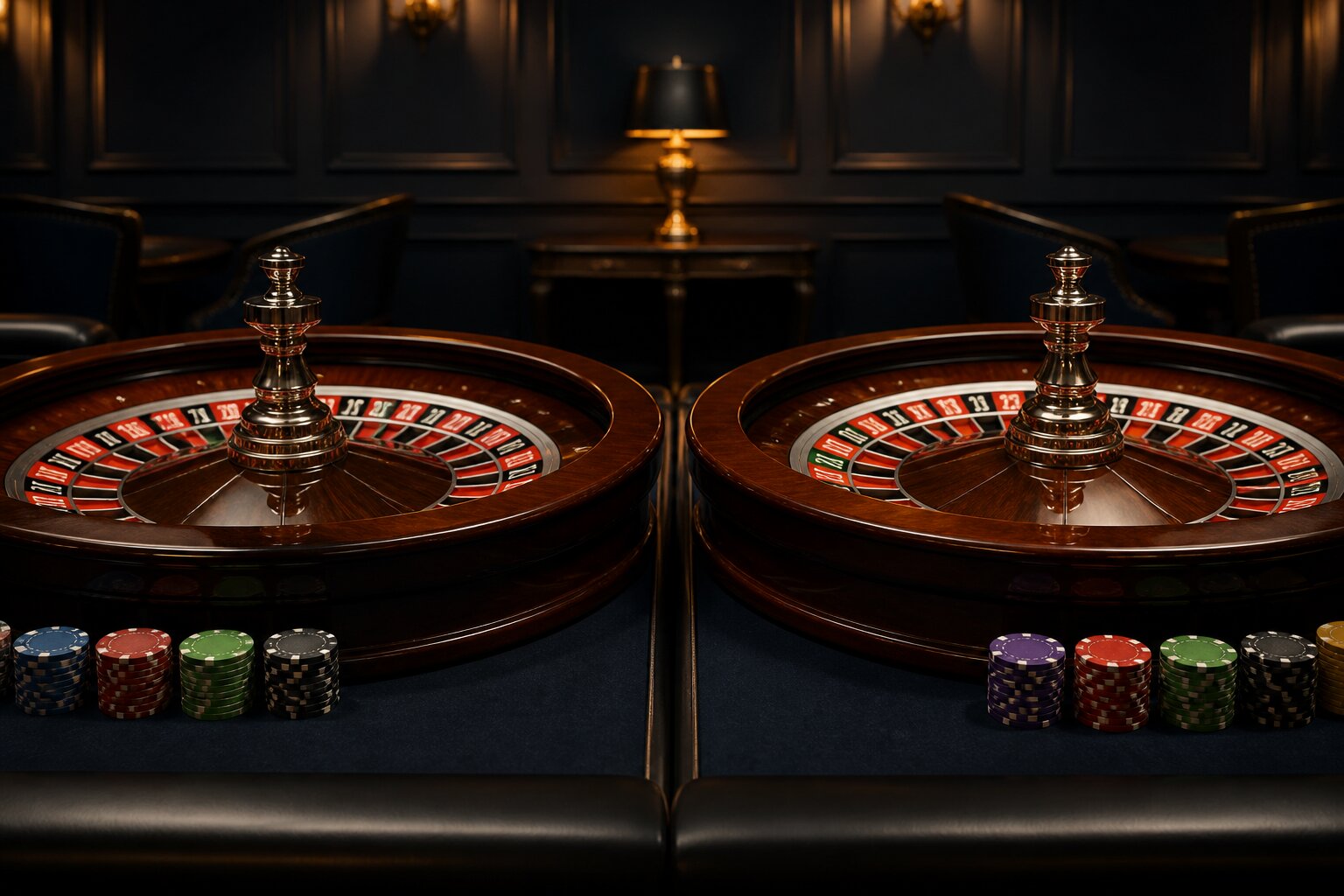
Roulette is one of the most recognisable casino games, with its spinning wheel and patterned table drawing players in. Not all roulette wheels are the same, though, and the differences affect the way the game plays and the odds you face.
Whether you’ve played before or are simply curious, this guide compares European and American Roulette so you can spot the differences and understand how they influence outcomes and strategy.
What Are The Key Differences Between European And American Roulette?
The clearest distinction is the number of pockets. European Roulette has 37 pockets numbered 0–36; American Roulette adds a second green pocket, labelled 00, bringing the total to 38. That extra pocket changes the odds on every bet.
Beyond pocket count, the wheel and table layouts differ. European tables display a single zero, while American tables show both 0 and 00, which alters where bets are placed and how the board looks at a glance. Some European games also include rules such as En Prison or La Partage, which alter how even-money bets are handled if the ball lands on zero; these rules are rarely offered in American games.
The available bet types are essentially the same in both versions, but the wheel configuration and special rules can affect how a session feels and how your bankroll behaves over time. Recognising which version you’re at helps set expectations before you place a bet.
How Do The Wheels Differ In European And American Roulette?
At a glance, the difference is the green pockets: one zero on European wheels, two on American wheels. The sequence of numbers around each wheel is also distinct; red and black still alternate, but the order and spacing change between versions to accommodate the extra pocket on the American wheel.
These physical differences influence the visual rhythm of the wheel and the distribution of outcomes. The additional pocket in American Roulette slightly alters the probability of the ball landing on any single number, and that in turn affects how often individual bets pay out over many spins.
Familiarity with the wheel you’re playing on makes it easier to read the table and compare the practical effects of various bets, without needing to memorise every sequence of numbers.
How Do Roulette Odds Compare Between The Versions?
Odds depend directly on the number of pockets. A straight-up bet—backing one number—has a 1 in 37 chance on the European wheel and a 1 in 38 chance on the American wheel. Even-money bets (for example, red or black) are also slightly less favourable on the American wheel because of the extra non-colour pocket.
These differences are small on a single spin but add up over many plays. The chances of winning on any one spin are governed by the wheel’s structure, not by previous outcomes, so the extra pocket simply shifts the statistical balance in favour of the house a little more in the American version.
Which Version Offers Better Payouts For Players?
Payout rates for winning bets are the same in both versions. For example:
- A single-number win still pays 35 to 1.
- Splits and rows pay at their usual rates.
- Even-money bets return at their standard rates.
The difference is in probability, not in the payout scale. Because the American wheel has extra pockets, the chance of a winning spin for any given wager is lower than on a European wheel. That means the frequency of wins falls, even though the amount paid when you do win remains unchanged.
Put another way, the expected return to the player is affected by the number of pockets rather than by the payout structure. The extra 00 on the American wheel increases the house edge, so over time wins occur less often relative to the amount staked.
Understanding House Edge In European vs American Roulette
House edge quantifies the casino’s mathematical advantage over many bets. In European Roulette this edge is typically around 2.7%, reflecting the presence of a single zero. In American Roulette the edge rises to roughly 5.26% because of the additional 00 pocket. How the House Edge Works in Online Casinos
This measure represents the average proportion of stakes retained by the house over time. It is a long-run statistic and does not predict the outcome of an individual spin, nor does it guarantee short-term losses or wins.
Knowing the house edge helps compare how different games are expected to perform against a player’s bankroll across extended play. It also informs a few practical points about play and expectations:
- The house edge applies over a large number of spins, so short sessions can deviate widely from the average.
- Higher house edge generally means the bankroll is expected to decrease faster on average during prolonged play.
- Lower house edge does not eliminate variance; players can still experience wins or losses regardless of the theoretical percentage.
Understanding these distinctions makes it easier to interpret what the percentages mean without implying certainty about any single bet or session.
Why Does American Roulette Have An Extra Zero?
When roulette travelled to the United States, the double zero was introduced in the 19th century. Casinos added the 00 pocket to increase the proportion of losing outcomes relative to winning ones, which is why American Roulette carries a higher house edge compared with the European version.
The extra pocket does not alter the mechanics of a spin: the wheel, ball and basic wager types remain the same. However, it does shift the underlying probabilities and therefore affects long-term results for players.
That historical change also led to a few noticeable differences between American and European games:
- Table layout: American wheels and betting layouts are arranged to include the 00 pocket, which changes the order of numbers and the appearance of the table.
- Probabilities: With two zeroes the chance of the ball landing on a winning number is slightly lower than in single-zero roulette.
- Betting dynamics: The presence of 00 affects the expected return on many bets, particularly even-money and single-number wagers.
In numerical terms, these probability changes translate into a higher house edge for American wheels than for single-zero wheels. This is a long-term statistical effect rather than something that changes how an individual spin behaves.
Are The Rules And Table Layouts Different?
Fundamentally the rules are the same: bets are placed on numbers, colours, or groupings, and the ball’s final position determines winning bets. Table layouts reflect the wheel configuration, so American tables include spaces for both 0 and 00, while European Roulette tables have a single zero space.
Some European tables may apply En Prison or La Partage rules, which reduce losses on even-money bets if the ball lands on zero by returning part or all of the stake under certain conditions. These rules do not commonly appear in American Roulette, so the betting experience can feel more forgiving on some European tables.
Understanding these layout and rule differences helps you evaluate the practical effect of each option before you play.
Common Myths About Roulette Odds Debunked
Several persistent myths cloud how people think about roulette. One is that past results influence future spins; each spin’s outcome is independent, so no sequence of previous results makes a particular outcome more or less likely on the next spin. Another myth is that betting systems such as Martingale provide a reliable route to profit—these only change bet size, not the underlying probabilities, and they can quickly lead to large losses against table limits or finite bankrolls.
Similarly, searching for “hot” or “cold” numbers does not improve predictive power. The mathematical structure of the wheel determines probabilities, so pattern-watching does not alter the distribution of outcomes.
If you want to approach the game intelligently, focus on differences in house edge and rules rather than attempting to outwit the spin.
How To Choose Between European And American Roulette
Choice comes down to what matters to you. If lower house edge and the possibility of favourable rules such as En Prison appeal, European Roulette is generally the better statistical option. If you prefer particular table layouts or local availability, you might encounter American Roulette more often in some venues.
Trying both versions in low-stakes or demo settings is a practical way to see which feels more comfortable. Think about how long you plan to play and whether small differences in edge will matter to your budget; for shorter sessions the two versions feel similar, but over longer play the edge difference becomes more significant.
Keep a clear limit on spending and play within it so the experience stays enjoyable and sustainable.
Whichever version you play, understanding the wheel, the rules and the house edge will help you make informed choices at the table and get more from your time playing.
**The information provided in this blog is intended for educational purposes and should not be construed as betting advice or a guarantee of success. Always gamble responsibly.