
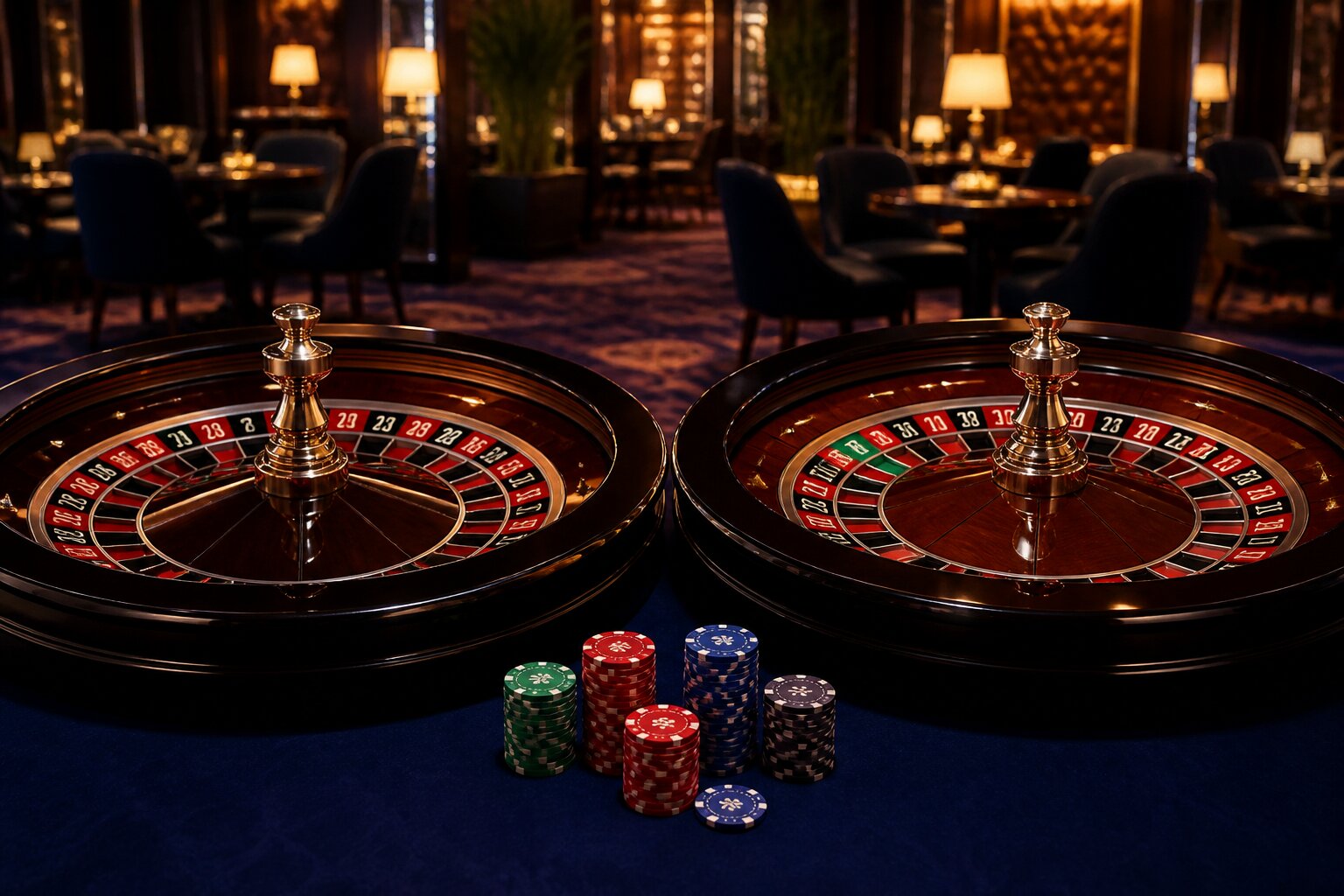
Roulette is a classic casino game with simple rules and a long history. Two main wheel styles dominate play: single zero and double zero roulette, and the differences between them affect how the game plays out.
If you want to choose the right table, it helps to understand how the wheels, layouts and odds differ. Read on to see what sets each version apart and what to look for when you next pick a seat.
Overview of Single Zero and Double Zero Roulette
Single zero roulette, commonly called European roulette, uses a wheel with one green zero and the numbers 1 to 36, giving a total of 37 pockets. This format is the usual option across most British casinos and in many online rooms. It is straightforward in layout and familiar to many players.
Double zero roulette, often labelled American roulette, adds a second green pocket marked 00, raising the total pockets to 38. That extra pocket changes the balance of the game and slightly alters the mathematical edge the house has over players.
Both versions share the same basic betting options and payouts, so the differences are concentrated in wheel layout and the probabilities that follow. Next, we will look at how those wheels are arranged and why the placement of the zeros matters for play.
How Do the Wheels Differ?
The most obvious contrast between the two wheels is the number of green pockets. Single zero wheels have one green 0; double zero wheels have both 0 and 00. The presence and placement of these green pockets change how the numbered sequence is distributed around the rim, which is an important part of the wheel’s design.
On a single zero wheel there are 37 pockets and the numbers alternate red and black around the rim, with the single green zero breaking that pattern. The order is arranged to spread high and low numbers and colours, which helps create an even distribution of outcomes across spins. For instance, certain numbers such as 32 may sit opposite the zero, reflecting that intentional balance.
A double zero wheel uses 38 pockets and separates the two green pockets so they are not adjacent. Typical layouts place 0 near 2 and 00 near 28, which produces a different rhythm to the number sequence than the single zero wheel. These differences do not change the basic bets available, but they do change the composition of the wheel you are watching.
Understanding the wheel layout makes it easier to see how the table is presented, so next we will examine how those differences appear on the betting layout and what that means for placing certain wagers.
Comparing Table Layouts
The table grid mirrors the wheel. On a single zero table you will see a single green 0 box at the top of the number grid, with three columns of numbers beneath and the usual outside bets—red/black, odd/even, high/low—arranged around the sides. This layout keeps chip placement clear for standard bets, including splits and corners.
Double zero tables show two boxes at the top of the grid, 0 and 00, set side by side. That additional box allows for specific bets such as the basket bet, which covers 0, 00, 1, 2 and 3, and alters where chips are placed for certain combinations. Aside from that extra area, the rest of the grid and the outside bet positions remain familiar.
For players who use particular combination bets or prefer a single, uncluttered top area, the table layout can be a deciding factor. With the layout in mind, the next section explains how these physical differences translate into the mathematical odds you face.
What Are the Odds and Payouts?
The payouts are the same across both versions, but the odds and house edge differ because of the additional pocket on the double zero wheel. Payouts such as 35 to 1 for a straight-up number or 1 to 1 for even-money bets do not change, so the main consideration is how often those outcomes occur. This means that while a winning stake receives the same return on either wheel, the chance of that win varies slightly between the two layouts.
Where the differences become important is in the relationship between those fixed payouts and the probabilities of winning. A higher number of pockets reduces the chance of any single outcome, so identical payouts translate into a lower expected return for the player when played on the wheel with the extra green pocket. Over one or a few spins this will be barely noticeable, but over many spins the effect becomes measurable.
House Edge Differences
Single zero roulette generally carries a house edge of about 2.7 percent, a figure that reflects one green pocket out of 37. In contrast, double zero roulette typically has a house edge around 5.26 percent, because the extra 00 increases the total pockets to 38. That difference represents a measurable change in the expected return over many spins.
The house edge is a long‑term average, not a prediction for any individual spin. It describes how, on average, the game will pay out relative to the money wagered over a very large number of bets. A higher house edge means the theoretical player loss per unit staked is greater over the long run, which is why even a seemingly small percentage difference can matter to some players and operators.
Probability of Winning
A straight-up bet on a single zero wheel has a 1 in 37 chance of winning, roughly 2.70 percent. On a double zero wheel the probability becomes 1 in 38, about 2.63 percent. Even-money bets show a similar small shift: 18 in 37 (around 48.6 percent) on single zero, versus 18 in 38 (about 47.4 percent) on double zero.
These shifts apply across the range of bets, so every market on the wheel is marginally less likely to win on the double zero layout. The change is modest for individual wagers, but it is consistent. Players who are monitoring long-term results or comparing games should take these probability differences into account when assessing which wheel to choose.
Payout Structures
Although the payout tables remain identical, the altered probabilities mean the same payout corresponds to a slightly different expected return depending on the wheel. That is why experienced players and many venues prefer single zero play when other factors are equal.
The practical effect is that single zero roulette tends to offer a better theoretical return to players compared with its double zero counterpart. This does not guarantee better outcomes in the short term, because roulette is a game of chance and variance can produce wide swings. Still, from a purely mathematical standpoint, the reduced number of pockets improves the expected value on each bet.
Having set out the odds, the following section describes how those numerical differences affect the feel of the game and the choices players make during play.
Gameplay Experience: What to Expect
Single zero roulette offers a simple, familiar experience: clear table markings, standard bets and a pace that suits both casual players and those who like a steady rhythm. Many casinos set accessible minimum and maximum bets to suit a range of budgets, and chip placement is straightforward for all common wagers.
Double zero roulette introduces slightly more variety in chip placement because of the extra betting box and options like the basket bet. That can make the table feel busier at the top and gives players small additional ways to structure wagers. Casinos that offer both types will often keep them on different tables so players can choose the format they prefer.
Whether you favour a single zero table for its slightly lower house edge or choose a double zero table for a particular bet mix, both deliver the same core gameplay elements: the spinning wheel, a clear set of bets and a consistent round structure. With that practical picture in mind, the next section looks at which version you are most likely to find when playing in the UK.
Which Version Is More Popular in the UK?
Single zero roulette is the dominant form of the game in Britain. It is the usual choice in most land-based casinos and appears as the main roulette option on the majority of online sites serving the UK market. Double zero or American roulette is rare domestically and tends to be offered only in certain international or specialist tables.
This prevalence reflects long-term local practice and the preferences of players and operators. For most people playing in the UK, the single zero format will be the default option when choosing a table. That makes it straightforward to find familiar rules and standard betting arrangements without hunting for a specific variant.
Whichever type of table you encounter, keep the differences in wheel design and house edge in mind when selecting where to play, and you will be able to choose the version that best fits your preferences and style.
Final note: single zero and double zero roulette deliver the same basic game with different mathematical profiles and table presentations, so knowing how they diverge helps you pick the right table and enjoy the experience with clearer expectations.
Play Online Casino Games at Easy Slots
We'd be delighted to welcome you to our site, where you can enjoy playing casino games at a pace that suits you. There’s no rush – just choose how you’d like to play and settle in.
Getting set up is simple: just create your account, make a deposit, and you’ll be ready to explore what we have to offer. We look forward to having you with us.
**The information provided in this blog is intended for educational purposes and should not be construed as betting advice or a guarantee of success. Always gamble responsibly.