
If you’ve ever sat down to play 3 Card Brag and wondered which hands are truly top notch, you’re not alone. Knowing the hand rankings is the key to making the best decisions at the table and getting more value from the hands you play.
With its fast pace and simple rules, 3 Card Brag is a popular social card game across the UK. When the cards are dealt, recognising which combinations beat others makes the difference between confidently staying in and folding at the right time.
In this guide we will list the hands from best to worst, explain the differences between them with clear examples, and clear up common misunderstandings so you can approach your next game with confidence.
What Is 3 Card Brag & How Does It Work?
3 Card Brag is a three-card comparing game played from a standard 52-card deck. Each player receives three cards face down and the objective is to hold the highest-ranking three-card combination at showdown. Before play begins most groups place an ante into the pot to create a stake for the round.
After the deal, players inspect their cards and choose whether to continue, raise where the rules allow, or fold. Betting proceeds until every remaining player has matched the last bet or folded. The surviving hands are then revealed and compared according to the game’s ranking system; the highest-ranking hand wins the pot.
Understanding how hands are compared is essential for making good decisions during betting and for knowing when a hand is strong enough to stay in. The next section breaks down those rankings so you can see where each combination sits.
How Are 3 Card Brag Hands Ranked?
Hands in 3 Card Brag are ranked by the rarity and hierarchical value of the card combinations. The hierarchy used in most common variants places three of a kind at the top, then straight flushes, runs, flushes, pairs, and finally high-card hands. Within each category, hands are ordered by the card values they contain.
These rankings determine the outcome at showdown and shape strategic choices during betting. The following sections describe each category in turn, starting with the highest-ranking hands and moving toward the weakest.
The Highest Ranking Hands Explained
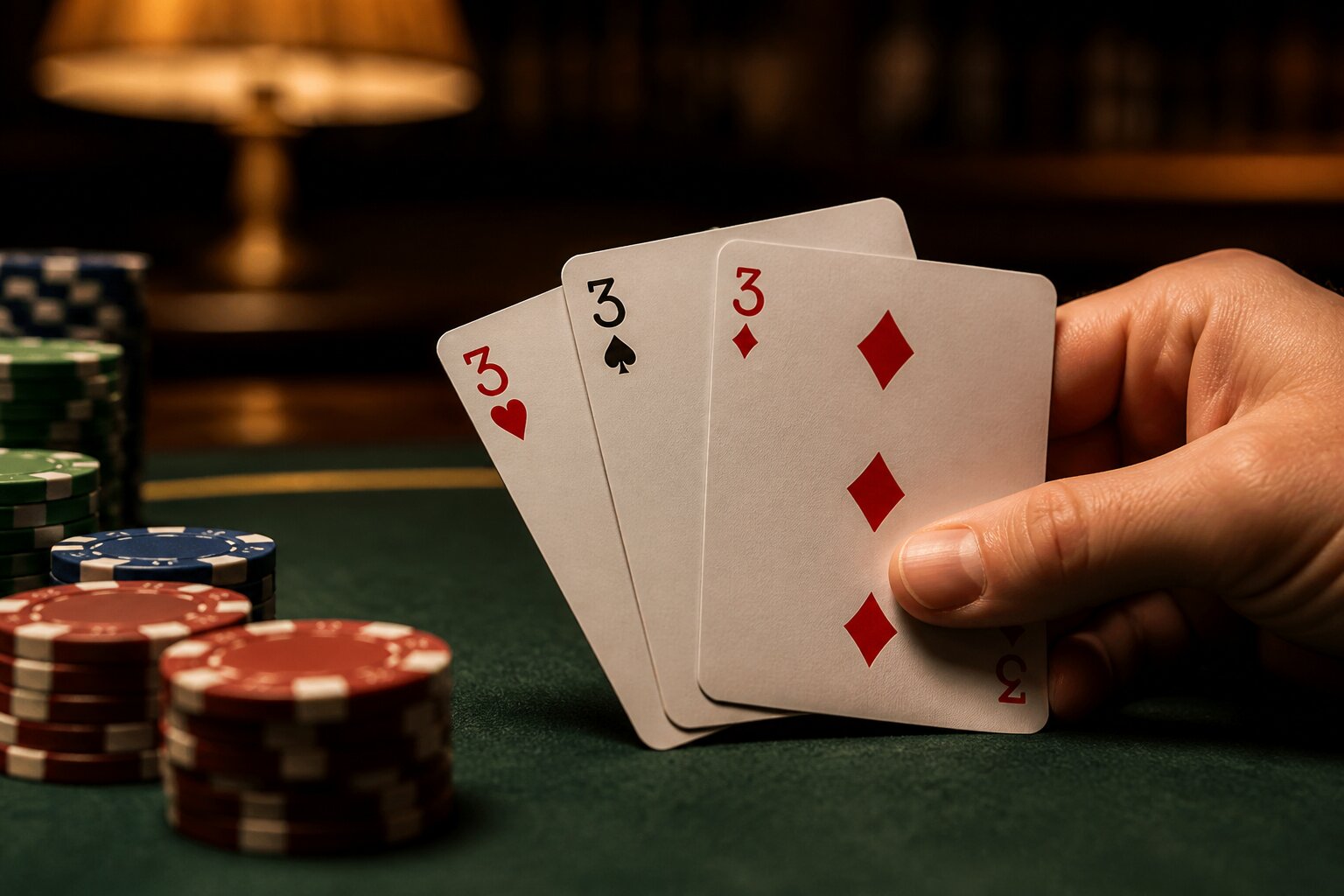
The top hand is a prial, short for pair royal, which is three cards of the same rank. Prials are compared by rank: three threes are the highest prial, followed by three aces, three kings, and so on down the pack. Because of this unusual ordering, a prial of threes will beat a prial of aces.
Next comes the running flush, also called a straight flush: three consecutive cards all in the same suit, for example 5-6-7 of hearts. In many rule sets A-2-3 is the highest running flush, followed by A-K-Q and so on.
A plain run, or straight, is three consecutive cards of mixed suits. Runs are ranked in the same value order as running flushes, with A-2-3 typically treated as the highest run. These top categories are rare and will usually determine the outcome immediately when they appear in a showdown. The next section examines the hands you are more likely to see and how they compare.
Middle Ranking Hands in Detail
If your hand is not a prial, running flush, or run, the next strongest type is a flush: three cards of the same suit that are not in sequence. Flushes are compared by the highest card in the hand, then the second, and then the third if needed. For example, K-J-8 of spades beats Q-10-5 of spades because the king outranks the queen.
Below flushes are pairs, where two of your three cards share the same rank. Pair hands are compared first by the rank of the pair and then by the side card, commonly called the kicker. So a pair of tens with an ace kicker beats a pair of tens with a king kicker. These middle-ranking hands are common enough that accurate assessment of their relative strength is important when deciding whether to remain in play.
The Lowest Ranking Hands to Avoid
The weakest category is the high-card hand, sometimes called no pair. These hands contain no matching ranks, no sequence, and no flush; their value comes from the highest single card and, if necessary, the second and third cards to break ties. For example, A-4-2 of mixed suits outranks K-8-3 of mixed suits because the ace is higher than the king.
High-card hands are frequently seen and tend to be folded in later betting rounds unless the pot odds or betting behaviour suggest a different choice. Knowing both where your hand sits and how opponents have been betting helps turn this information into better decisions.
Pairs, Prials, Straights & Flushes: What’s the Difference?
Understanding the specific definitions of each hand type removes doubt at showdown and helps with on-the-fly comparisons.
A pair means two cards of the same rank plus an unrelated third card. Examples include 7 of clubs, 7 of diamonds, and 3 of spades.
A prial is three cards of the same rank and is the rarest and strongest hand. Examples include three threes or three aces.
A straight or run is three consecutive ranks in any suits. Examples include 6-7-8 and A-2-3.
A flush is three cards of the same suit that are not consecutive. Examples include 2-6-10 of clubs or 8-queen-king of spades.
Each of these categories follows the hierarchy described earlier; knowing which label to apply to your cards is the first step to correctly evaluating their strength. Next, the following section shows direct comparisons of common hands so you can see which beats which in practice.
What Hand Beats What in 3 Card Brag?
Below are clear examples showing how the main hand types compare when they meet at showdown. Each example is chosen to illustrate the ranking order without depending on suit for tie-breaking.
- Prial (three of a kind) beats everything else. Example: 3♣ 3♦ 3♥ defeats a running flush such as 5♥ 6♥ 7♥.
- Running flush (straight flush) beats a run and any lower hand. Example: 5♥ 6♥ 7♥ defeats a plain run like 10♠ J♦ Q♣.
- Run (straight) beats flushes and lower hands. Example: 10♠ J♦ Q♣ defeats a flush such as 2♠ 7♠ Q♠.
- Flush beats pairs and high-card hands. Example: 2♠ 7♠ Q♠ defeats a pair like 8♦ 8♠ 5♥.
- Pair beats any high-card hand. Example: 8♦ 8♠ 5♥ defeats a high-card hand such as A♦ 7♣ 4♠.
- High-card hands lose to any of the above. Example: A♦ 7♣ 4♠ will lose to a pair, a flush, a run, and so on.
These comparisons make it easy to judge outcomes at showdown and to sense how strong an opponent’s betting might be. The next section clears up some recurring misunderstandings about these ranks so you can avoid common mistakes.
Common Misconceptions About 3 Card Brag Hands
Several ideas circulate among players that do not match the usual 3 Card Brag ranking rules. One is that a straight is always weaker than a flush as in some poker variants; here, a straight outranks a flush. Another mistaken belief is that A-K-Q is the highest run; in typical play A-2-3 ranks above A-K-Q. It is also incorrect to assume all prials are equivalent; prials are ordered by rank with three threes at the top.
Some players think suits decide ties between identical combinations. In practice, identical combinations are compared by card rank rather than suit, and most games have a standard procedure for resolving exact ties should they occur. Understanding these points reduces confusion during showdowns and helps interpret opponents’ actions more clearly. You will now be better prepared to read hands and spot when a player’s behaviour suggests a top combination.
Age restrictions apply to gambling activities; play only if you are 18 or over and set sensible limits for stakes you can afford. With that in mind, use this guide to sharpen your recognition of hands and improve how you assess strength in each round.
Explore Casino Games at Easy Slots
At Easy Slots, you can browse a range of casino games and consider which options, if any, are suitable for you. Whether you’re familiar with online casino games or simply want to understand what’s available, take your time and make your own choice.
Responsible gambling tools are available to help you set limits, monitor your play and maintain control. If you decide to create an account, registration is straightforward, but there’s no need to rush your decision.
Before gambling, consider what you can afford to lose and remember that gambling should be treated as entertainment, not a way to make money.
**The information provided in this blog is intended for educational purposes and should not be construed as betting advice or a guarantee of success. Always gamble responsibly.