
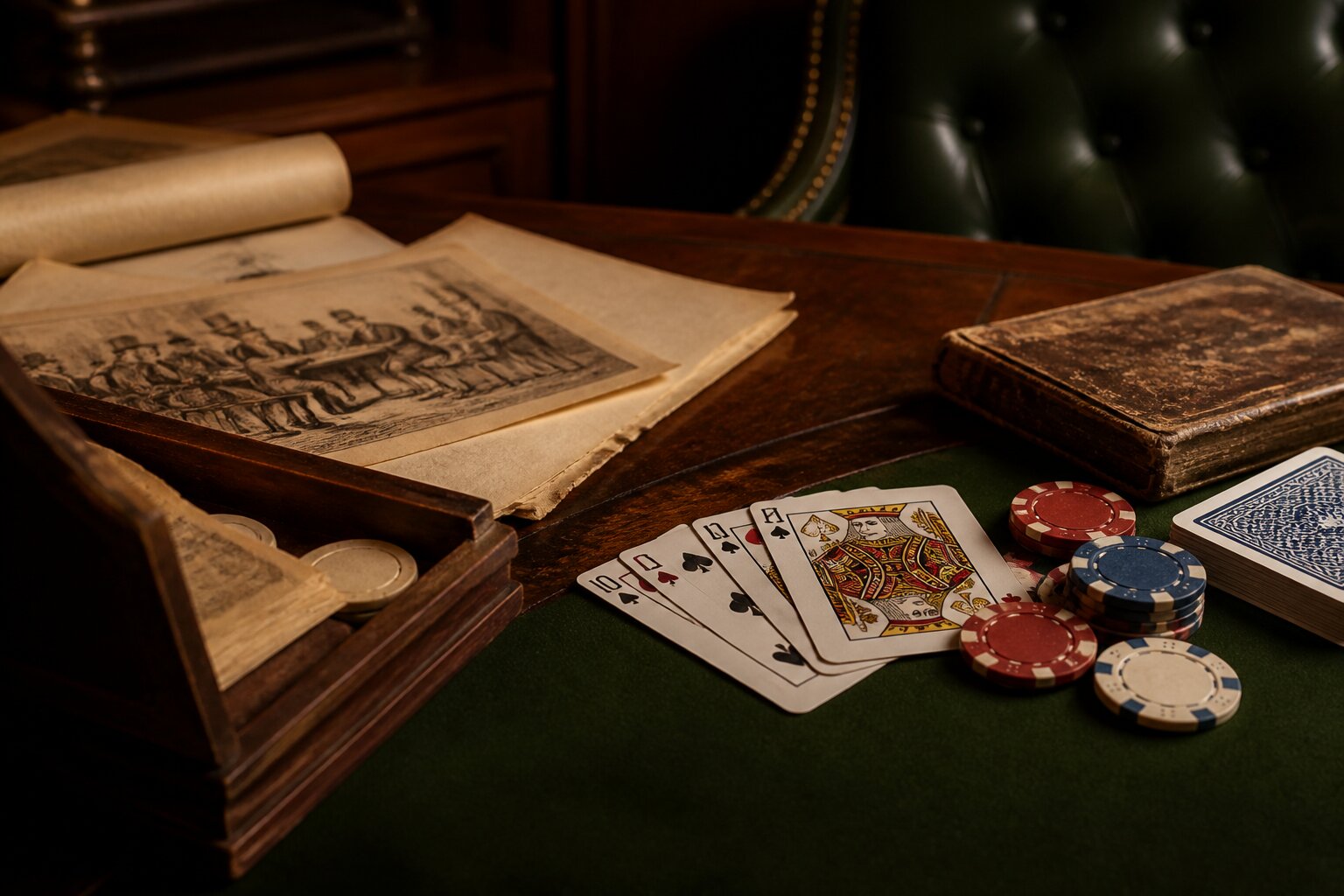
Poker is one of the world’s most played card games, but its beginnings are not clear-cut. The story mixes ancient pastimes, regional games and centuries of gradual change rather than a single moment of invention.
As cards and their rules moved between cultures, poker absorbed different ideas—betting, bluffing and ranked hands—until it became recognisably its own game. The journey is full of surprising detours and curious characters that shaped how the game is played today.
Ready to trace that path? We will follow the threads that fed into poker’s rise and see how older games left their mark.
What Is the True Origin of Poker?
There is no single, agreed origin for poker. Historians view it as a family of features that came together over time, rather than a game invented outright by one person or in one place.
Several older games are commonly linked to poker. The Persian game As Nas, from around the 16th century, used ranked hands and featured betting rounds and bluffing. In France, Poque in the 18th century involved wagering and deception, while the German Pochen shared similar mechanics. English Brag emphasised bluffing and combinations, and likely influenced players in Britain and beyond.
These games travelled with traders, settlers and sailors, allowing rules and ideas to mix. As a result, poker appears to be an evolutionary blend: not one origin but several influences coming together to form a new pattern of play.
How Did Poker Evolve Into Its Modern Form?
Poker became more recognisable in the early 1800s in the United States, where it was played in river towns and on paddle steamers. Early versions used a 20-card deck and straightforward betting, but as the game spread, changes followed to suit different players and environments.
Switching to a full 52-card deck expanded the possible hands and strategies, and variants began to emerge. Draw Poker and Stud Poker introduced different ways of handling cards and betting rounds, and later forms such as Texas Hold’em added new dynamics that emphasised community cards and positional play.
The 20th century brought organised tournaments and wider exposure through television, which helped standardise some forms of play while leaving plenty of room for local rules. Through this gradual reshaping, poker moved from a regional pastime to an internationally recognised competitive game.
Influential Early Card Games Connected to Poker
To understand poker’s development, it helps to look at the earlier games that supplied key mechanics. These predecessors contributed features such as:
- betting phases
- hand rankings
- strategic deception
Those basic ideas provided the scaffold on which later games were built, and they reappeared in modified form as rules evolved.
Ancient and Mediaeval Card Game Roots
Playing cards first appear in historical records several centuries ago, and by the medieval period they had spread across Asia, the Middle East and Europe. Early games were varied in style and purpose, but many involved grouping cards into sets or sequences. These organising principles are straightforward but powerful, and they later informed many modern card games.
Play in these earlier games often emphasised pattern recognition and probability, and players learned to judge the value of combinations. As rules were adapted to local tastes, features that rewarded particular combinations or that allowed wagering became more common. Over time, those adaptations created a repertoire of techniques and conventions that could be mixed and matched.
The Influence of French, Persian, and British Card Games
The Persian As Nas contributed the idea of ranked hands and structured betting rounds, setting out a clear relationship between different combinations. French Poque and German Pochen introduced elements of bluffing and wagering mechanics that look familiar to poker players today, stressing the psychological side of play as much as the cards themselves. British Brag emphasised deception and hand-building strategies, encouraging players to mislead opponents and to construct winning combinations from limited information.
Rather than claiming a single ancestor, it is more accurate to see a cross-pollination of influences. Travellers, merchants and soldiers carried games to new places, and local players merged favourite features into fresh variations. Over decades those shared elements gradually coalesced into proto-poker forms that retained traces of these diverse lineages.
Is There Fact or Myth Behind Poker’s Invention Story?
Many tales about poker’s invention are part fact and part folklore. Clear records show that card games with similar features existed long before modern poker, but stories that assign a dramatic single origin or inventor lack solid evidence.
What remains solid is the pattern of gradual change: rules adapted to social settings, new variants arose to suit different tastes, and the game evolved through cultural exchange. It is better to think in terms of a slow formation rather than a single moment of creation.
That perspective also helps separate romanticised origin stories from the real historical process, where incremental adjustments and regional preferences mattered most.
How Did Poker Spread Globally?
Poker’s spread followed familiar routes of migration, trade and travel. As people carried their games with them, local communities adapted rules and created new variants that fitted regional tastes.
In North America, games brought by European settlers mixed with local traditions, particularly in port cities and along river routes where travellers and workers met. New variants proliferated as the game moved across the continent, and later spread internationally through migration and media.
The result is a global family of poker styles, from informal home games to organised tournaments and online play. Wherever it went, the game absorbed influences and adapted, which explains the wide variety of rules and play styles seen today.
What Was the Early Reception of Poker in the UK?
When poker reached the UK in the 19th century, reactions were varied. Players familiar with bluffing games like Brag found some common ground, while others treated poker as a foreign novelty worth watching before adopting.
Public interest grew cautiously; poker did not instantly replace established British card games, but it carved out its place among other pastimes. Contemporary accounts mix curiosity with concern, reflecting how new leisure activities were scrutinised for social and moral impact.
Over time poker settled into British gaming culture as one among several card games enjoyed in clubs and private gatherings, and it has since become part of the wider recreational scene.
How Has Poker’s Identity Changed Over Time?
Poker’s identity has shifted from an informal social game to a regulated, spectator-friendly activity with competitive structures. The move from private tables to casinos, televised tournaments and online platforms changed expectations around rules, conduct and player protection.
Regulation and oversight have been important in this process, aiming to ensure fair play and to protect participants. At the same time, poker’s image has moved into mainstream entertainment and competitive sport, with professional tournaments and widely followed events.
Despite these changes, the core attractions remain: strategic decision making, psychological reading of opponents and the challenge of adapting to different formats. Poker today sits at the intersection of social play, competition and regulated entertainment, and that balance shapes how people experience the game.
Final note: poker’s history is a story of gradual invention and cultural mixing, and its modern form reflects centuries of adaptation. Wherever it is played, the emphasis is on fair, regulated environments and on enjoying the game in a responsible way.
**The information provided in this blog is intended for educational purposes and should not be construed as betting advice or a guarantee of success. Always gamble responsibly.