
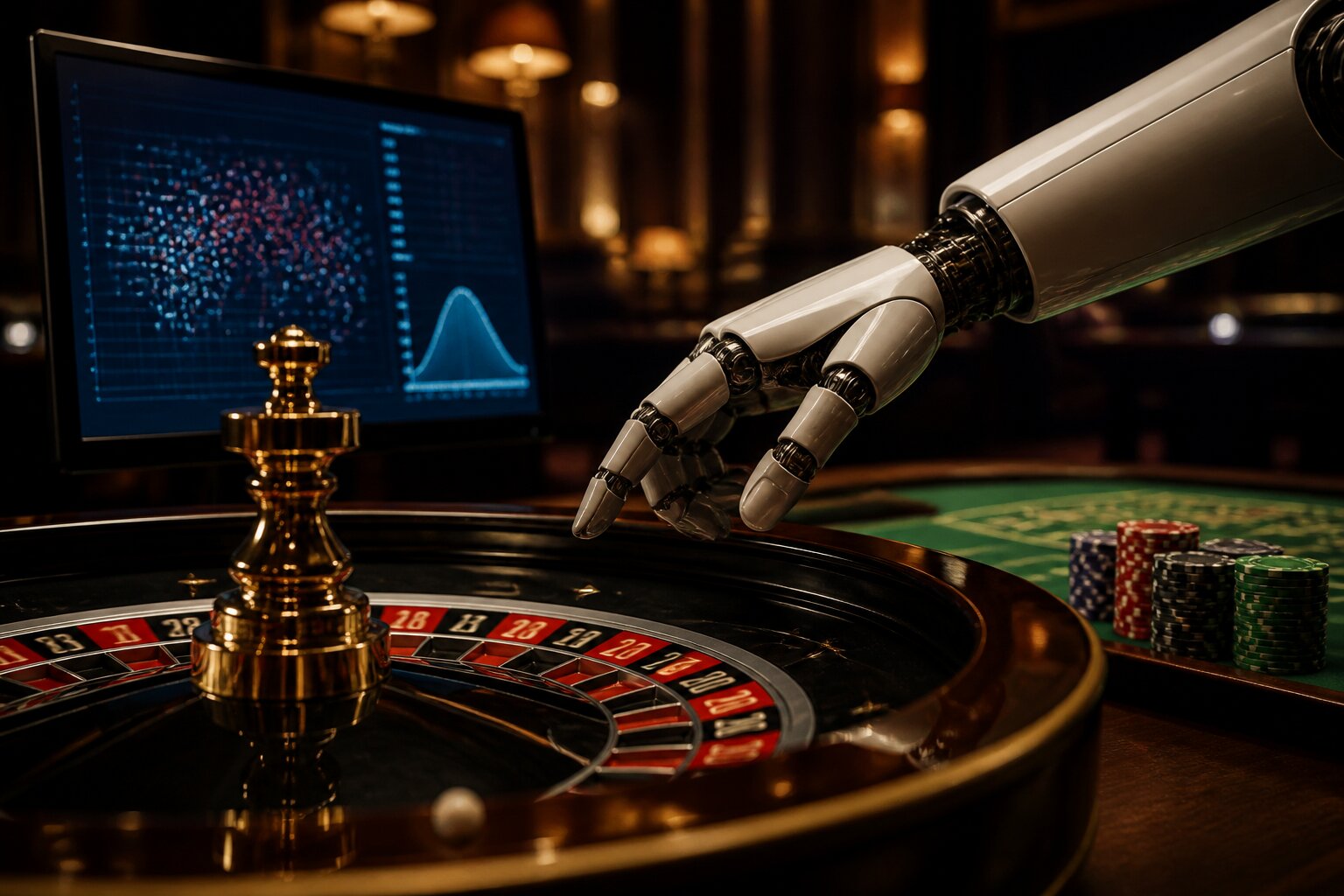
Have you ever wondered if artificial intelligence could crack the code of the roulette wheel? With machine learning and clever bots making headlines, it’s tempting to picture algorithms outwitting the casino.
Behind that headline-friendly idea, though, lies a much more complicated reality shaped by mathematics, carefully designed randomness and stringent regulation. Keep reading to see what technology can and cannot do when it comes to roulette—and where the true limits lie.
How Does AI Try to Predict Roulette Outcomes?
At its simplest, AI looks for patterns in data. Some projects feed long lists of past spins into machine-learning models, hoping to detect numbers or sequences that appear to repeat. Others focus on physical cues: the speed of the wheel, the ball’s motion or where the ball was released. In experimental settings, high-speed cameras and sensors can measure these details precisely, and researchers test whether tiny mechanical biases might affect outcomes.
Those physical approaches are possible only in specific, controlled circumstances. Online roulette uses certified random number generators (RNGs) that make each spin independent of the last, so historical results have no predictive value. In real casinos, constant monitoring, changing conditions and robust anti-cheat measures put further obstacles in the way of any predictive approach.
This leads naturally to the next question: what techniques do people actually try when they attempt prediction?
Common Machine Learning Techniques Used in Roulette Prediction
A range of machine-learning methods have been applied to roulette data, even though the results do not translate into a reliable advantage.
Neural networks attempt to learn complex relationships in sequences of past spins or timing data. In controlled tests they sometimes appear to fit apparent patterns, but those patterns are usually coincidental rather than repeatable in fresh data.
Regression analysis is used to test whether measurable variables—wheel speed, ball release timing, or the croupier’s technique—correlate with outcomes. When such correlations occur, they are typically tiny and quickly disappear once conditions change or surveillance tightens.
Decision trees and ensemble methods break possibilities into branches and weigh probabilities across them. These models can be helpful in many domains, yet in roulette their branching tends to reflect noise rather than a stable signal.
None of these methods have been demonstrably effective against properly operated RNGs or in well-managed casinos. The technical work can be interesting from a research perspective, but it does not translate into practical, persistent gains for players. That limitation points toward another important topic: automated programs that play for you.
The Role of Bots in Online Roulette
Bots automate betting behaviour: placing wagers rapidly, applying a preset staking system, or tracking outcomes to adjust play. They are attractive because they remove repetitive manual tasks and can execute strategies without delay.
However, most legitimate operators prohibit unauthorised bots. Online casinos monitor play patterns and use automated detection to identify accounts that behave like software rather than people. Where bots are detected, accounts can be suspended or closed.
Even where bots operate without being detected for a time, they do not overcome the randomness produced by certified RNGs. A program may speed up play or enforce discipline, but it cannot change the underlying probabilities of each spin. With that in mind, it is worth looking at the combined legal and technical limits that define what is and isn’t feasible.
What Are the Genuine Limits of AI and Bots in Roulette?
The limits are both technical and regulatory. Roulette is structured so that each spin is independent and measurable biases are either eliminated or monitored. Online games use tested RNGs; physical casinos maintain surveillance and device checks. Together, these measures make it effectively impossible for AI or bots to achieve a consistent edge.
Predictive systems face practical barriers: data that appears to show patterns will evaporate as soon as play conditions change, and detection systems quickly flag unusual behaviour. Those realities exist alongside legal constraints that restrict attempts to alter or bypass game operation.
Legal and Ethical Considerations
UK legislation makes clear that interfering with or attempting to manipulate gaming systems is unlawful. Using devices or software to gain an unfair advantage can lead to criminal charges, civil penalties and forfeiture of winnings. Licensed operators must also demonstrate that games are fair and transparent, with independent testing of software and compliance checks.
Ethically, using tools designed to distort play undermines the integrity of gaming for everyone. Operators have responsibilities to protect players and ensure an even playing field, while players are expected to follow terms and conditions and the law.
Technical Barriers in Real-World Casinos
Technical protections are extensive. Online, RNGs operate within audited frameworks that make sequential outcomes independent and uniformly distributed. Physical venues combine wheel maintenance, randomisation practices and active floor surveillance to remove or detect mechanical biases.
Security teams and testing labs look for tampering, unauthorised devices and anomalous play patterns. That environment leaves little room for a predictive system to function over any meaningful period, which helps explain why claims of long-term AI success are not supported by the evidence.
With those constraints in mind, the next section asks the core question directly.
Can AI Prediction Ever Beat the Roulette Wheel?
No validated AI method can beat roulette as offered by properly regulated operators. Outcomes in licensed games are governed by statistical rules that ensure the house retains a fixed advantage over the long run. For example, European roulette typically has a return-to-player (RTP) around 97.3%, reflecting the game’s mathematical structure rather than any short-term variance.
Academic studies and industry evaluations have repeatedly shown that apparent short-term gains are not sustained once all factors—regulation, monitoring and randomness—are accounted for. Predictive experiments may demonstrate intriguing results in narrow lab settings, but they do not translate to a practical route to profit in everyday play.
Understanding why these limits exist helps dispel persistent myths, which is what the next section addresses.
Myths and Misconceptions About AI Roulette Prediction
Several recurring myths exaggerate what AI can achieve in roulette.
One is that machines always find genuine patterns in spin histories. In regulated play, apparent sequences are usually random clustering rather than meaningful signals. Another is that bots can reliably beat live dealer games; in reality, close monitoring, wheel maintenance and surveillance make long-term success from automation highly unlikely.
A related misconception is that past results help forecast the next spin. Mathematical independence means each spin’s outcome does not depend on previous spins, so using historical results as a predictive tool is flawed by design.
Finally, claims that paid prediction systems guarantee profit are not supported by credible evidence. No certified product can remove the house edge or ensure returns.
If concerns about gambling ever arise, support services exist for those who want them.
This review shows that while AI and automation make for interesting research and occasional short-term stories, they do not overturn the fundamental structure of roulette. Regulation, testing and design protect the fairness of the game, and in that environment the long-term limits on prediction remain firmly in place.
Play Online Casino Games at Easy Slots
We’re delighted to welcome you to our site, where you’ll find a friendly space to enjoy online casino games at your own pace. Whether you’re new or returning, we’re here to make your experience as enjoyable as possible.
**The information provided in this blog is intended for educational purposes and should not be construed as betting advice or a guarantee of success. Always gamble responsibly.